∑math20

Number theory · Result 014

Restricted geometric Langlands, global Arthur enhancements, and generic Ramanujan

8 papers

Proves the restricted geometric Langlands equivalence for connected reductive groups on smooth projective connected curves over \(\overline{\mathbb F}_q\) under the four stated Lie-theoretic characteristic hypotheses. Over arbitrary algebraically closed fields of characteristic p > 0, the same conclusion holds assuming additionally that p is very good for the group and \(p\nmid |W_G|\). Over global function fields, proves Ramanujan at every place for globally generic cuspidal representations of split adjoint absolutely simple exceptional groups, without characteristic or ramification-depth restrictions, and at every unramified place for cuspidal representations of split adjoint absolutely simple groups with a generic unramified component. Assuming the finite-level Ramanujan–Arthur decomposition, constructs global Arthur enhancements of occurring cuspidal excursion parameters for split connected semisimple groups at full finite level, recovering the given parameters by diagonal specialization on the entire Weil group, including inertia.

Watch

▶Introduction: the problem and why it mattersin preparation
▶The presented solutionin preparation

Papers 8

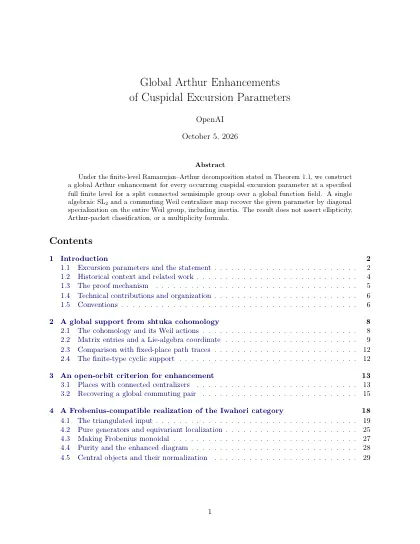
First page of Global Arthur Enhancements of Cuspidal Excursion Parameters

Global Arthur Enhancements of Cuspidal Excursion Parameters

OpenAI · October 5, 2026

Under the finite-level Ramanujan–Arthur decomposition stated in Theorem 1.1, we construct a global Arthur enhancement for every occurring cuspidal excursion parameter at a specified full finite level for a split connected semisimple group over a global function field. A single algebraic SL2 and a commuting Weil centralizer map recover the given parameter by diagonal specialization on the entire Weil group, including inertia. The result does not assert ellipticity, Arthur-packet classification, or a multiplicity formula.

Read PDF Download Source

Cite
@misc{OAI:Global-Arthur-Enhancements-of-Cuspidal-Excursion-Parameters-October-5-2026,
  author = {{OpenAI}},
  title = {{Global Arthur Enhancements of Cuspidal Excursion Parameters}},
  howpublished = {OpenAI Math Release preprint
                  \href{https://github.com/openai/math/blob/main/preprints/Global-Arthur-Enhancements-of-Cuspidal-Excursion-Parameters-October-5-2026/manuscript.pdf}{OAI:Global-Arthur-Enhancements-of-Cuspidal-Excursion-Parameters-October-5-2026}},
  year = {2026}
}
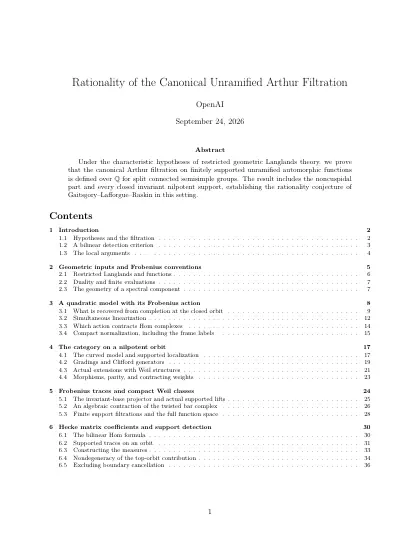
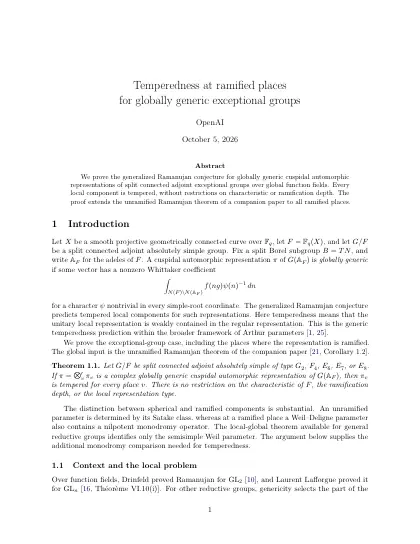
First page of Rationality of the Canonical Unramified Arthur Filtration

Rationality of the Canonical Unramified Arthur Filtration

OpenAI · September 24, 2026

Under the characteristic hypotheses of restricted geometric Langlands theory, we prove that the canonical Arthur filtration on finitely supported unramified automorphic functions is defined over ℚ for split connected semisimple groups. The result includes the noncuspidal part and every closed invariant nilpotent support, establishing the rationality conjecture of Gaitsgory–Lafforgue–Raskin in this setting.

Read PDF Download Source

Cite
@misc{OAI:Rationality-of-the-Canonical-Unramified-Arthur-Filtration-September-24-2026,
  author = {{OpenAI}},
  title = {{Rationality of the Canonical Unramified Arthur Filtration}},
  howpublished = {OpenAI Math Release preprint
                  \href{https://github.com/openai/math/blob/main/preprints/Rationality-of-the-Canonical-Unramified-Arthur-Filtration-September-24-2026/paper.pdf}{OAI:Rationality-of-the-Canonical-Unramified-Arthur-Filtration-September-24-2026}},
  year = {2026}
}
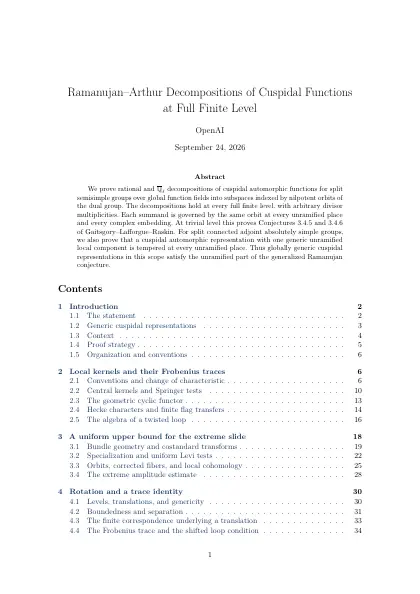
First page of Ramanujan-Arthur Decompositions of Cuspidal Functions at Full Finite Level

Ramanujan-Arthur Decompositions of Cuspidal Functions at Full Finite Level

OpenAI · September 24, 2026

We prove rational and \(\overline{\mathbb Q}_\ell\) decompositions of cuspidal automorphic functions for split semisimple groups over global function fields into subspaces indexed by nilpotent orbits of the dual group. The decompositions hold at every full finite level, with arbitrary divisor multiplicities. Each summand is governed by the same orbit at every unramified place and every complex embedding. At trivial level this proves Conjectures 3.4.5 and 3.4.6 of Gaitsgory–Lafforgue–Raskin. For split connected adjoint absolutely simple groups, we also prove that a cuspidal automorphic representation with one generic unramified local component is tempered at every unramified place. Thus globally generic cuspidal representations in this scope satisfy the unramified part of the generalized Ramanujan conjecture.

Read PDF Download Source

Cite
@misc{OAI:Ramanujan-Arthur-Decompositions-of-Cuspidal-Functions-at-Full-Finite-Level-September-24-2026,
  author = {{OpenAI}},
  title = {{Ramanujan--Arthur Decompositions of Cuspidal Functions at Full Finite Level}},
  howpublished = {OpenAI Math Release preprint
                  \href{https://github.com/openai/math/blob/main/preprints/Ramanujan-Arthur-Decompositions-of-Cuspidal-Functions-at-Full-Finite-Level-September-24-2026/paper.pdf}{OAI:Ramanujan-Arthur-Decompositions-of-Cuspidal-Functions-at-Full-Finite-Level-September-24-2026}},
  year = {2026}
}
First page of Temperedness at ramified places for globally generic exceptional groups

Temperedness at ramified places for globally generic exceptional groups

OpenAI · October 5, 2026

We prove the generalized Ramanujan conjecture for globally generic cuspidal automorphic representations of split connected adjoint exceptional groups over global function fields. Every local component is tempered, without restrictions on characteristic or ramification depth. The proof extends the unramified Ramanujan theorem of a companion paper to all ramified places.

Read PDF Download Source

Cite
@misc{OAI:Temperedness-at-ramified-places-for-globally-generic-exceptional-groups-October-5-2026,
  author = {{OpenAI}},
  title = {{Temperedness at ramified places for globally generic exceptional groups}},
  howpublished = {OpenAI Math Release preprint
                  \href{https://github.com/openai/math/blob/main/preprints/Temperedness-at-ramified-places-for-globally-generic-exceptional-groups-October-5-2026/ramified-ramanujan.pdf}{OAI:Temperedness-at-ramified-places-for-globally-generic-exceptional-groups-October-5-2026}},
  year = {2026}
}
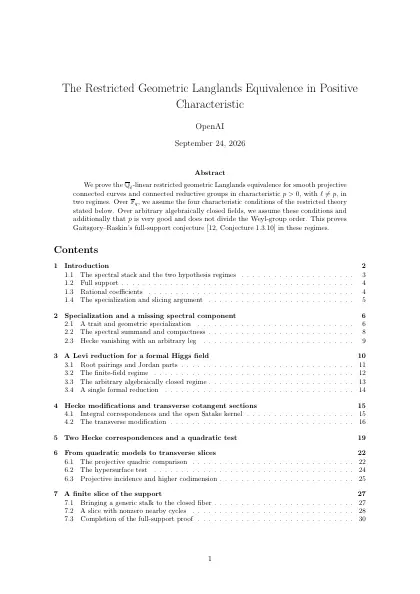
First page of The Restricted Geometric Langlands Equivalence in Positive Characteristic

The Restricted Geometric Langlands Equivalence in Positive Characteristic

OpenAI · September 24, 2026

We prove the \(\overline{\mathbb Q}_\ell\)-linear restricted geometric Langlands equivalence for smooth projective connected curves and connected reductive groups in characteristic p > 0, with ℓ ≠ p, in two regimes. Over \(\overline{\mathbb F}_q\), we assume the four characteristic conditions of the restricted theory stated below. Over arbitrary algebraically closed fields, we assume these conditions and additionally that p is very good and does not divide the Weyl-group order. This proves Gaitsgory–Raskin's full-support conjecture [[12, Conjecture 1.3.10]](https://arxiv.org/abs/2508.02237v1) in these regimes.

Read PDF Download Source

Cite
@misc{OAI:The-Restricted-Geometric-Langlands-Equivalence-in-Positive-Characteristic-September-24-2026,
  author = {{OpenAI}},
  title = {{The Restricted Geometric Langlands Equivalence in Positive Characteristic}},
  howpublished = {OpenAI Math Release preprint
                  \href{https://github.com/openai/math/blob/main/preprints/The-Restricted-Geometric-Langlands-Equivalence-in-Positive-Characteristic-September-24-2026/paper.pdf}{OAI:The-Restricted-Geometric-Langlands-Equivalence-in-Positive-Characteristic-September-24-2026}},
  year = {2026}
}
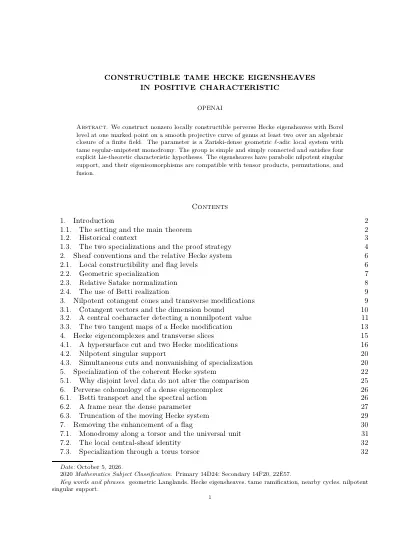
First page of Constructible tame Hecke eigensheaves in positive characteristic

Constructible tame Hecke eigensheaves in positive characteristic

OpenAI · October 5, 2026

We construct nonzero locally constructible perverse Hecke eigensheaves with Borel level at one marked point on a smooth projective curve of genus at least two over an algebraic closure of a finite field. The parameter is a Zariski-dense geometric ℓ-adic local system with tame regular-unipotent monodromy. The group is simple and simply connected and satisfies four explicit Lie-theoretic characteristic hypotheses. The eigensheaves have parabolic nilpotent singular support, and their eigenisomorphisms are compatible with tensor products, permutations, and fusion.

Read PDF Download Source

Cite
@misc{OAI:Constructible-tame-Hecke-eigensheaves-in-positive-characteristic-October-5-2026,
  author = {{OpenAI}},
  title = {{Constructible tame Hecke eigensheaves in positive characteristic}},
  howpublished = {OpenAI Math Release preprint
                  \href{https://github.com/openai/math/blob/main/preprints/Constructible-tame-Hecke-eigensheaves-in-positive-characteristic-October-5-2026/constructible-tame-hecke-eigensheaves-positive-characteristic.pdf}{OAI:Constructible-tame-Hecke-eigensheaves-in-positive-characteristic-October-5-2026}},
  year = {2026}
}
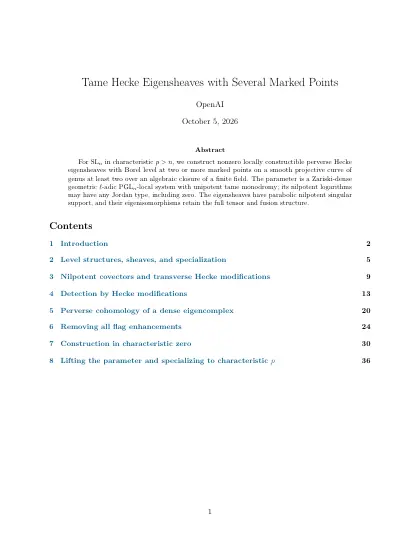
First page of Tame Hecke Eigensheaves with Several Marked Points

Tame Hecke Eigensheaves with Several Marked Points

OpenAI · October 5, 2026

For SLn in characteristic p > n, we construct nonzero locally constructible perverse Hecke eigensheaves with Borel level at two or more marked points on a smooth projective curve of genus at least two over an algebraic closure of a finite field. The parameter is a Zariski-dense geometric ℓ-adic PGLn-local system with unipotent tame monodromy; its nilpotent logarithms may have any Jordan type, including zero. The eigensheaves have parabolic nilpotent singular support, and their eigenisomorphisms retain the full tensor and fusion structure.

Read PDF Download Source

Cite
@misc{OAI:Tame-Hecke-Eigensheaves-with-Several-Marked-Points-October-5-2026,
  author = {{OpenAI}},
  title = {{Tame Hecke Eigensheaves with Several Marked Points}},
  howpublished = {OpenAI Math Release preprint
                  \href{https://github.com/openai/math/blob/main/preprints/Tame-Hecke-Eigensheaves-with-Several-Marked-Points-October-5-2026/Tame-Hecke-Eigensheaves-with-Several-Marked-Points.pdf}{OAI:Tame-Hecke-Eigensheaves-with-Several-Marked-Points-October-5-2026}},
  year = {2026}
}
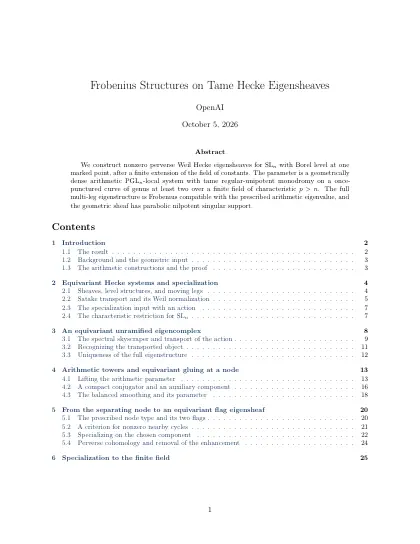
First page of Frobenius Structures on Tame Hecke Eigensheaves

Frobenius Structures on Tame Hecke Eigensheaves

OpenAI · October 5, 2026

We construct nonzero perverse Weil Hecke eigensheaves for SLn with Borel level at one marked point, after a finite extension of the field of constants. The parameter is a geometrically dense arithmetic PGLn-local system with tame regular-unipotent monodromy on a once-punctured curve of genus at least two over a finite field of characteristic p > n. The full multi-leg eigenstructure is Frobenius compatible with the prescribed arithmetic eigenvalue, and the geometric sheaf has parabolic nilpotent singular support.

Read PDF Download Source

Cite
@misc{OAI:Frobenius-Structures-on-Tame-Hecke-Eigensheaves-October-5-2026,
  author = {{OpenAI}},
  title = {{Frobenius Structures on Tame Hecke Eigensheaves}},
  howpublished = {OpenAI Math Release preprint
                  \href{https://github.com/openai/math/blob/main/preprints/Frobenius-Structures-on-Tame-Hecke-Eigensheaves-October-5-2026/tame-hecke-frobenius.pdf}{OAI:Frobenius-Structures-on-Tame-Hecke-Eigensheaves-October-5-2026}},
  year = {2026}
}
Formal verification

No Lean formalization is listed for this result yet. The repository notes that unformalized results could have issues.