∑math20

Algebraic and complex geometry · Result 036

Numerical semiampleness and generalized minimal models

4 papers

Proves numerical semiampleness for nef adjoints \(K_X+B+M\) with \(K_X+B\) pseudo-effective and M nef rational, for projective klt rational pairs over algebraically closed characteristic-zero fields and smooth compact Kähler rational klt simple-normal-crossing pairs, using Bott–Chern cohomology in the latter case. Separately, projective generalized log canonical rational pairs over such fields admit minimal models for pseudo-effective adjoints and Mori fiber spaces otherwise, with nef b-data fixed.

Watch

1

The problem

What is being asked, where it comes from, and why it is hard. No proof needed.

▶Introduction to the problemin preparation
2

The solution proposed by OpenAI

How the paper solves it, step by step.

Full explanation
▶The proposed solutionin preparation

Papers 4

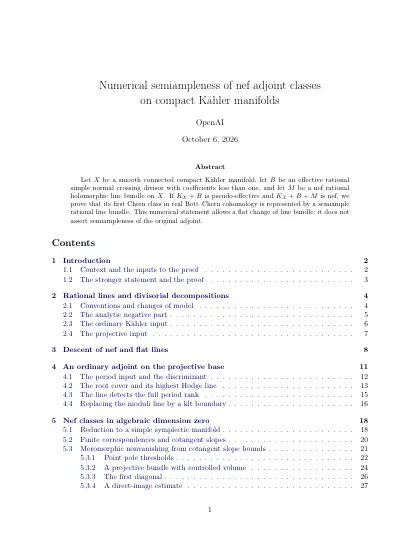
First page of Numerical semiampleness of nef adjoint classes on compact Kähler manifolds

Numerical semiampleness of nef adjoint classes on compact Kähler manifolds

OpenAI · October 6, 2026

Let X be a smooth connected compact Kähler manifold, let B be an effective rational simple normal crossing divisor with coefficients less than one, and let M be a nef rational holomorphic line bundle on X. If \(K_X+B\) is pseudo-effective and \(K_X+B+M\) is nef, we prove that its first Chern class in real Bott–Chern cohomology is represented by a semiample rational line bundle. This numerical statement allows a flat change of line bundle; it does not assert semiampleness of the original adjoint.

This version states the Iitaka, model, and contraction inputs used in the divisorial-decomposition argument explicitly; see the previous version.

Read PDF Download Source

Cite
@misc{OAI:Numerical-semiampleness-of-nef-adjoint-classes-on-compact-Kahler-manifolds-October-6-2026,
  author = {{OpenAI}},
  title = {{Numerical semiampleness of nef adjoint classes on compact K{\"a}hler manifolds}},
  howpublished = {OpenAI Math Release preprint
                  \href{https://github.com/openai/math/blob/main/preprints/Numerical-semiampleness-of-nef-adjoint-classes-on-compact-Kahler-manifolds-October-6-2026/numerical-generalized-abundance.pdf}{OAI:Numerical-semiampleness-of-nef-adjoint-classes-on-compact-Kahler-manifolds-October-6-2026}},
  year = {2026}
}
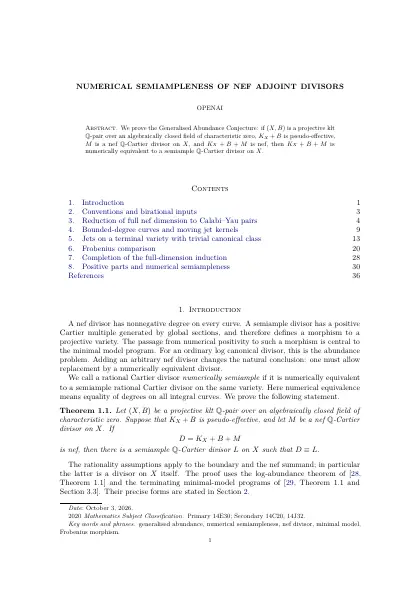
First page of Numerical Semiampleness of Nef Adjoint Divisors

Numerical Semiampleness of Nef Adjoint Divisors

OpenAI · October 3, 2026

We prove the Generalised Abundance Conjecture: if \((X,B)\) is a projective klt ℚ-pair over an algebraically closed field of characteristic zero, \(K_X+B\) is pseudo-effective, M is a nef ℚ-Cartier divisor on X, and \(K_X+B+M\) is nef, then \(K_X+B+M\) is numerically equivalent to a semiample ℚ-Cartier divisor on X.

Read PDF Download Source

Cite
@misc{OAI:Numerical-Semiampleness-of-Nef-Adjoint-Divisors-October-3-2026,
  author = {{OpenAI}},
  title = {{Numerical Semiampleness of Nef Adjoint Divisors}},
  howpublished = {OpenAI Math Release preprint
                  \href{https://github.com/openai/math/blob/main/preprints/Numerical-Semiampleness-of-Nef-Adjoint-Divisors-October-3-2026/paper.pdf}{OAI:Numerical-Semiampleness-of-Nef-Adjoint-Divisors-October-3-2026}},
  year = {2026}
}
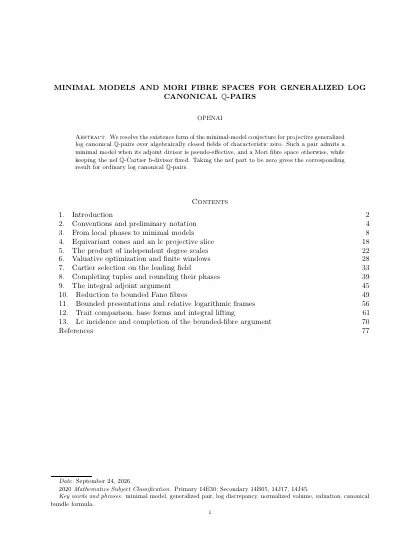
First page of Minimal models and Mori fibre spaces for generalized log canonical Q-pairs

Minimal models and Mori fibre spaces for generalized log canonical Q-pairs

OpenAI · September 24, 2026

We resolve the existence form of the minimal-model conjecture for projective generalized log canonical ℚ-pairs over algebraically closed fields of characteristic zero. Such a pair admits a minimal model when its adjoint divisor is pseudo-effective, and a Mori fibre space otherwise, while keeping the nef ℚ-Cartier b-divisor fixed. Taking the nef part to be zero gives the corresponding result for ordinary log canonical ℚ-pairs.

Read PDF Download Source

Cite
@misc{OAI:Minimal-models-and-Mori-fibre-spaces-for-generalized-log-canonical-Q-pairs-September-24-2026,
  author = {{OpenAI}},
  title = {{Minimal models and Mori fibre spaces for generalized log canonical $\mathbb{Q}$-pairs}},
  howpublished = {OpenAI Math Release preprint
                  \href{https://github.com/openai/math/blob/main/preprints/Minimal-models-and-Mori-fibre-spaces-for-generalized-log-canonical-Q-pairs-September-24-2026/paper.pdf}{OAI:Minimal-models-and-Mori-fibre-spaces-for-generalized-log-canonical-Q-pairs-September-24-2026}},
  year = {2026}
}
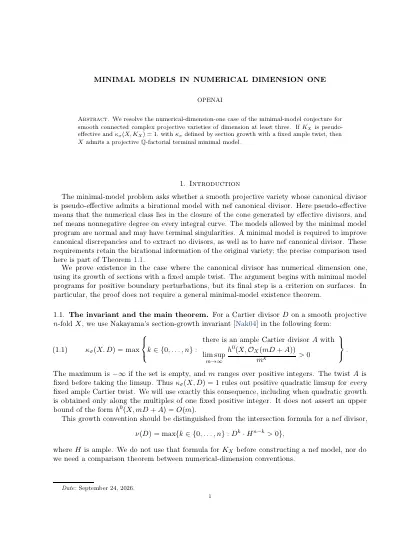
First page of Minimal models in numerical dimension one

Minimal models in numerical dimension one

OpenAI · September 24, 2026

We resolve the numerical-dimension-one case of the minimal-model conjecture for smooth connected complex projective varieties of dimension at least three. If KX is pseudo-effective and \(\kappa_\sigma(X,K_X)=1\), with κσ defined by section growth with a fixed ample twist, then X admits a projective ℚ-factorial terminal minimal model.

Read PDF Download Source

Cite
@misc{OAI:Minimal-models-in-numerical-dimension-one-September-24-2026,
  author = {{OpenAI}},
  title = {{Minimal models in numerical dimension one}},
  howpublished = {OpenAI Math Release preprint
                  \href{https://github.com/openai/math/blob/main/preprints/Minimal-models-in-numerical-dimension-one-September-24-2026/paper.pdf}{OAI:Minimal-models-in-numerical-dimension-one-September-24-2026}},
  year = {2026}
}

Formal verification

No Lean formalization is listed for this result yet. The repository notes that unformalized results could have issues.