∑math20

Theoretical computer science · Result 102

The Unique Games Conjecture and optimal approximation thresholds

5 papersLeanreasoning

Proves Khot's Unique Games Conjecture. Independent direct reductions also establish NP-hardness, on unweighted graphs, of approximation beyond the Goemans–Williamson ratio for Max-Cut, below factor two for Vertex Cover, and within any fixed constant factor for Min-UnCut and directed feedback vertex set. These direct proofs use established PCP and Label Cover hardness results.

Watch

▶Introduction: the problem and why it mattersin preparation
▶The presented solutionin preparation

Papers 5

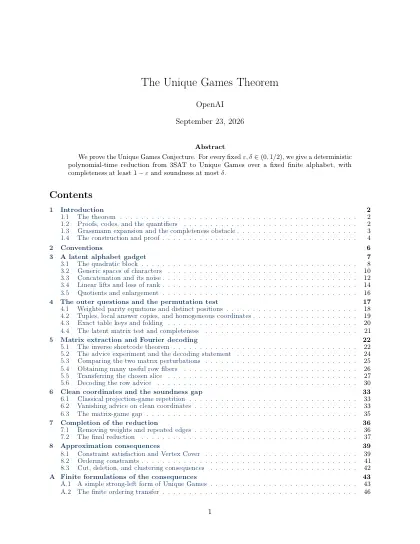
First page of The Unique Games Theorem

The Unique Games Theorem

OpenAI · September 23, 2026

We prove the Unique Games Conjecture. For every fixed \(\varepsilon,\delta\in(0,1/2)\), we give a deterministic polynomial-time reduction from 3SAT to Unique Games over a fixed finite alphabet, with completeness at least \(1-\varepsilon\) and soundness at most δ.

Read PDF Download Source

Cite
@misc{OAI:The-Unique-Games-Theorem-September-23-2026,
  author = {{OpenAI}},
  title = {{The Unique Games Theorem}},
  howpublished = {OpenAI Math Release preprint
                  \href{https://github.com/openai/math/blob/main/preprints/The-Unique-Games-Theorem-September-23-2026/paper.pdf}{OAI:The-Unique-Games-Theorem-September-23-2026}},
  year = {2026}
}
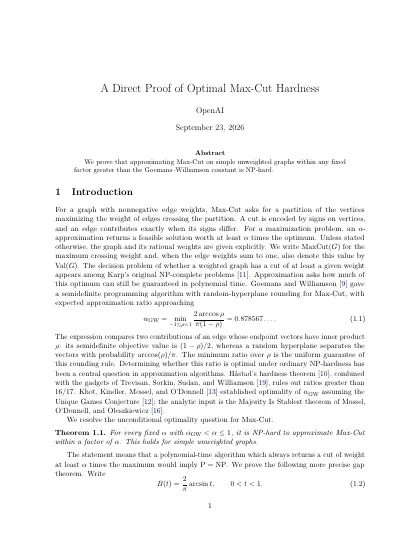
First page of A Direct Proof of Optimal Max-Cut Hardness

A Direct Proof of Optimal Max-Cut Hardness

OpenAI · September 23, 2026

We prove that approximating Max-Cut on simple unweighted graphs within any fixed factor greater than the Goemans–Williamson constant is NP-hard.

Read PDF Download Source

Cite
@misc{OAI:A-Direct-Proof-of-Optimal-Max-Cut-Hardness-September-23-2026,
  author = {{OpenAI}},
  title = {{A Direct Proof of Optimal Max-Cut Hardness}},
  howpublished = {OpenAI Math Release preprint
                  \href{https://github.com/openai/math/blob/main/preprints/A-Direct-Proof-of-Optimal-Max-Cut-Hardness-September-23-2026/paper.pdf}{OAI:A-Direct-Proof-of-Optimal-Max-Cut-Hardness-September-23-2026}},
  year = {2026}
}
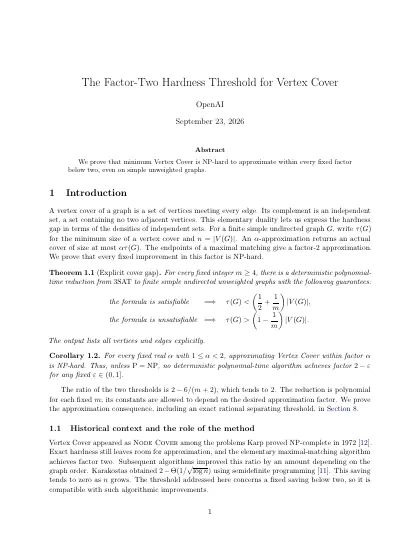
First page of The Factor-Two Hardness Threshold for Vertex Cover

The Factor-Two Hardness Threshold for Vertex Cover

OpenAI · September 23, 2026

We prove that minimum Vertex Cover is NP-hard to approximate within every fixed factor below two, even on simple unweighted graphs.

Read PDF Download Source

Cite
@misc{OAI:The-Factor-Two-Hardness-Threshold-for-Vertex-Cover-September-23-2026,
  author = {{OpenAI}},
  title = {{The Factor-Two Hardness Threshold for Vertex Cover}},
  howpublished = {OpenAI Math Release preprint
                  \href{https://github.com/openai/math/blob/main/preprints/The-Factor-Two-Hardness-Threshold-for-Vertex-Cover-September-23-2026/paper.pdf}{OAI:The-Factor-Two-Hardness-Threshold-for-Vertex-Cover-September-23-2026}},
  year = {2026}
}
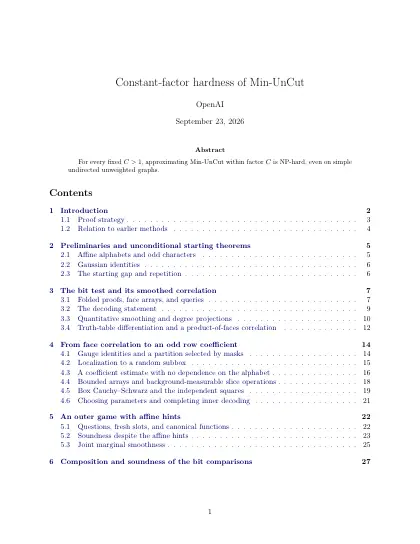
First page of Constant-factor hardness of Min-UnCut

Constant-factor hardness of Min-UnCut

OpenAI · September 23, 2026

For every fixed C > 1, approximating Min-UnCut within factor C is NP-hard, even on simple undirected unweighted graphs.

Read PDF Download Source

Cite
@misc{OAI:Constant-factor-hardness-of-Min-UnCut-September-23-2026,
  author = {{OpenAI}},
  title = {{Constant-factor hardness of Min-UnCut}},
  howpublished = {OpenAI Math Release preprint
                  \href{https://github.com/openai/math/blob/main/preprints/Constant-factor-hardness-of-Min-UnCut-September-23-2026/paper.pdf}{OAI:Constant-factor-hardness-of-Min-UnCut-September-23-2026}},
  year = {2026}
}
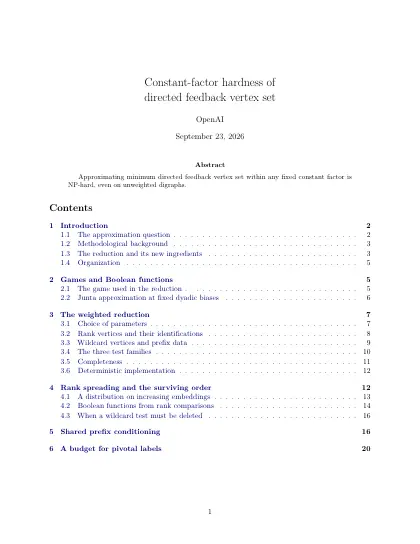
First page of Constant-factor hardness of directed feedback vertex set

Constant-factor hardness of directed feedback vertex set

OpenAI · September 23, 2026

Approximating minimum directed feedback vertex set within any fixed constant factor is NP-hard, even on unweighted digraphs.

Read PDF Download Source

Cite
@misc{OAI:Constant-factor-hardness-of-directed-feedback-vertex-set-September-23-2026,
  author = {{OpenAI}},
  title = {{Constant-factor hardness of directed feedback vertex set}},
  howpublished = {OpenAI Math Release preprint
                  \href{https://github.com/openai/math/blob/main/preprints/Constant-factor-hardness-of-directed-feedback-vertex-set-September-23-2026/paper.pdf}{OAI:Constant-factor-hardness-of-directed-feedback-vertex-set-September-23-2026}},
  year = {2026}
}

What was formalized in Lean

The following describes the scope of the Lean formalization related to the following accompanying paper(s):

Scope

The Unique Games conjecture asks for hardness of distinguishing nearly satisfiable unique games from games of very small value. The formalized result gives, for every fixed \(0<\varepsilon,\delta<1/2\), a deterministic polynomial-time reduction from binary 3SAT to nonempty unweighted simple bipartite unique games. Satisfiable inputs have value at least \(1-\varepsilon\) and unsatisfiable inputs have value at most \(\delta\). The alphabet is a fixed \(\mathbb F_2^s\) depending only on the errors, and every constraint is a translation.

The formalized result establishes hardness of approximating Max-Cut beyond the Goemans–Williamson constant \(\alpha_{\mathrm{GW}}\). For every fixed \(\alpha_{\mathrm{GW}}<\alpha\le1\), it gives a deterministic polynomial-time reduction from binary 3SAT to a strictly separated Max-Cut gap on finite simple unweighted graphs. The reduction includes the explicit positive integer scaling used in the gap statement.

The formalized result gives the factor-two hardness threshold for Vertex Cover. For each integer \(m\ge4\), a polynomial-time reduction from binary 3SAT produces simple unweighted graphs with cover density below \(1/2+1/m\) on satisfiable inputs and above \(1-1/m\) on unsatisfiable inputs. Consequently, any polynomial-time approximation with a fixed factor \(1\le\alpha<2\) would give a polynomial-time decision algorithm for 3SAT. No assumption that \(P\ne NP\) is built into the statement.

Min-UnCut minimizes the number of edges left uncut by a bipartition. The formalization constructs a deterministic reduction from encoded \(3\)-SAT formulas to finite simple unweighted Min-UnCut instances with arbitrarily large fixed multiplicative gaps. For every integer \(K\ge2\), satisfiable formulas give optimum at most the output threshold, while unsatisfiable formulas give optimum strictly greater than \(K\) times that threshold. Runtime and output length are polynomial for each fixed \(K\), establishing hardness for every fixed approximation factor greater than one.

A directed feedback vertex set meets every directed cycle. The formalization proves hardness of approximating the minimum such set within any fixed constant factor. For every real factor \(A\ge1\) and every language in NP, it constructs a polynomial-time gap reduction to unweighted directed graphs with the stated completeness and soundness separation. Thus a fixed-factor polynomial-time approximation would imply a polynomial-time algorithm for every NP language.

Comparator links

ResultComparator statement
Unique Games gap reductionUniqueGamesTheorem.lean
Optimal Max-Cut hardness gapOptimalMaxCut.lean
Vertex Cover gap and factor-two hardnessVertexCover.lean
Arbitrary constant-factor hardness of Min-UnCutMinUncut.lean
Constant-factor hardness of directed feedback vertex setDirectedFeedback.lean

Scope note on GitHub →

Reasoning summary

OpenAI released an abridged summary of the model's reasoning for this result: Ordinary NP-hardness at the basic semidefinite threshold (PDF).