∑math20

Theoretical computer science · Result 119

The Courtade–Kumar and Hellinger conjectures

2 papersLean

Proves the Courtade–Kumar conjecture: among Boolean functions of independent uniform bits, a single coordinate retains the most mutual information after independent bit-flip noise. A stronger theorem treats randomized binary summaries at fixed initial information. The Hellinger conjecture is also proved for every Boolean output bias and noise correlation.

Watch

▶Introduction: the problem and why it mattersin preparation
▶The presented solutionin preparation

Papers 2

First page of Sharp binary-information contraction on the discrete cube

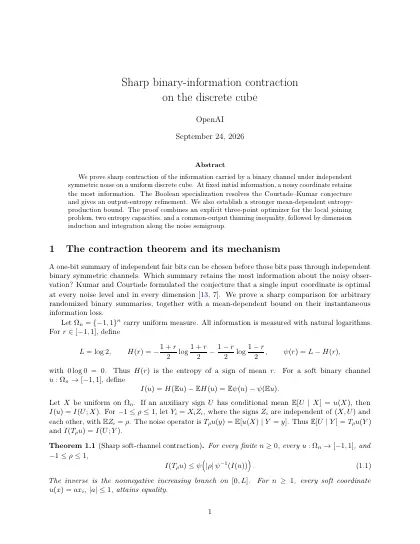
Sharp binary-information contraction on the discrete cube

OpenAI · September 24, 2026

We prove sharp contraction of the information carried by a binary channel under independent symmetric noise on a uniform discrete cube. At fixed initial information, a noisy coordinate retains the most information. The Boolean specialization resolves the Courtade–Kumar conjecture and gives an output-entropy refinement. We also establish a stronger mean-dependent entropy-production bound. The proof combines an explicit three-point optimizer for the local joining problem, two entropy capacities, and a common-output thinning inequality, followed by dimension induction and integration along the noise semigroup.

Read PDF Download Source

Cite
@misc{OAI:Sharp-binary-information-contraction-on-the-discrete-cube-September-24-2026,
  author = {{OpenAI}},
  title = {{Sharp binary-information contraction on the discrete cube}},
  howpublished = {OpenAI Math Release preprint
                  \href{https://github.com/openai/math/blob/main/preprints/Sharp-binary-information-contraction-on-the-discrete-cube-September-24-2026/main.pdf}{OAI:Sharp-binary-information-contraction-on-the-discrete-cube-September-24-2026}},
  year = {2026}
}
First page of Hellinger contraction with arbitrary Boolean output bias

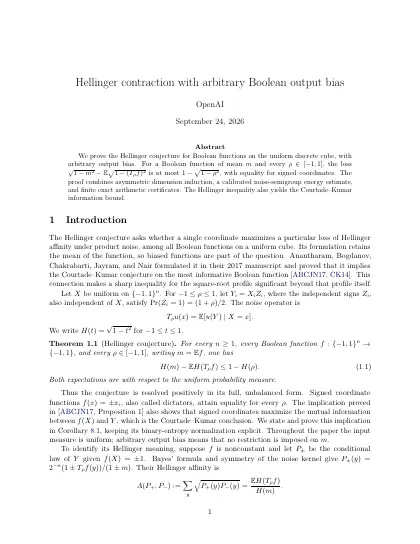
Hellinger contraction with arbitrary Boolean output bias

OpenAI · September 24, 2026

We prove the Hellinger conjecture for Boolean functions on the uniform discrete cube, with arbitrary output bias. For a Boolean function of mean m and every \(\rho\in[-1,1]\), the loss \(\sqrt{1-m^2}-\mathbb E\sqrt{1-(T_\rho f)^2}\) is at most \(1-\sqrt{1-\rho^2}\), with equality for signed coordinates. The proof combines asymmetric dimension induction, a calibrated noise-semigroup energy estimate, and finite exact arithmetic certificates. The Hellinger inequality also yields the Courtade–Kumar information bound.

Read PDF Download Source

Cite
@misc{OAI:Hellinger-contraction-with-arbitrary-Boolean-output-bias-September-24-2026,
  author = {{OpenAI}},
  title = {{Hellinger contraction with arbitrary Boolean output bias}},
  howpublished = {OpenAI Math Release preprint
                  \href{https://github.com/openai/math/blob/main/preprints/Hellinger-contraction-with-arbitrary-Boolean-output-bias-September-24-2026/main.pdf}{OAI:Hellinger-contraction-with-arbitrary-Boolean-output-bias-September-24-2026}},
  year = {2026}
}

What was formalized in Lean

The following describes the scope of the Lean formalization related to the following accompanying paper(s):

Scope

The formalization proves sharp contraction of the information carried by a binary channel under independent symmetric noise on a uniform discrete cube. At each fixed initial information level, a noisy coordinate channel attains the maximum retained information. It also proves the refined Boolean bound that accounts for output bias, with strict improvement for nonconstant biased outputs at nonzero noise correlation, and the selected mean-dependent entropy-production inequality.

For Boolean functions this includes the Courtade–Kumar inequality \(I(f(X);Y)\le1-h_2(\varepsilon)\) in bits at crossover probability \(0\le\varepsilon\le1/2\), where \(h_2\) is binary entropy. A coordinate and its complement attain equality.

Comparator links

ResultComparator statement
Courtade–Kumar inequality and attainmentCourtadeKumar.lean
Sharp binary-channel contraction and entropy productionSoftChannel204.lean

Scope note on GitHub →