∑math20

Combinatorics · Result 167

Planar distinct distances and unit-distance bounds

2 papersLean

Proves the weak pinned Erdős distance conjecture: for every fixed ε > 0, all but \(o(n)\) points of any n-point planar set determine at least \(n^{1-\varepsilon}\) distinct nonzero distances. A complementary theorem bounds the number of unit-distance pairs by \(O(n^{4/3-\delta})\) for an absolute δ > 0.

Watch

1

The problem

What is being asked, where it comes from, and why it is hard. No proof needed.

▶Introduction to the problemin preparation
2

The solution proposed by OpenAI

How the paper solves it, step by step.

Full explanation
▶The proposed solutionin preparation

Papers 2

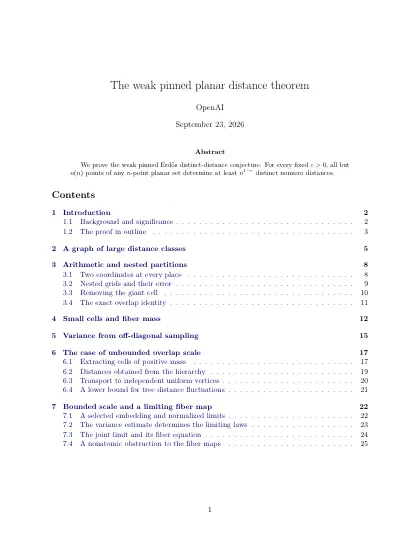
First page of The weak pinned planar distance theorem

The weak pinned planar distance theorem

OpenAI · September 23, 2026

We prove the weak pinned Erdős distinct-distance conjecture. For every fixed ε > 0, all but \(o(n)\) points of any n-point planar set determine at least \(n^{1-\varepsilon}\) distinct nonzero distances.

Read PDF Download Source

Cite
@misc{OAI:The-weak-pinned-planar-distance-theorem-September-23-2026,
  author = {{OpenAI}},
  title = {{The weak pinned planar distance theorem}},
  howpublished = {OpenAI Math Release preprint
                  \href{https://github.com/openai/math/blob/main/preprints/The-weak-pinned-planar-distance-theorem-September-23-2026/paper.pdf}{OAI:The-weak-pinned-planar-distance-theorem-September-23-2026}},
  year = {2026}
}
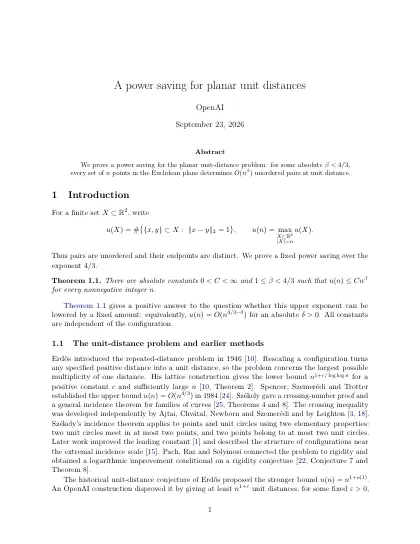
First page of A power saving for planar unit distances

A power saving for planar unit distances

OpenAI · September 23, 2026

We prove a power saving for the planar unit-distance problem: for some absolute \(\beta\lt 4/3\), every set of n points in the Euclidean plane determines \(O(n^\beta)\) unordered pairs at unit distance.

Read PDF Download Source

Cite
@misc{OAI:A-power-saving-for-planar-unit-distances-September-23-2026,
  author = {{OpenAI}},
  title = {{A power saving for planar unit distances}},
  howpublished = {OpenAI Math Release preprint
                  \href{https://github.com/openai/math/blob/main/preprints/A-power-saving-for-planar-unit-distances-September-23-2026/paper.pdf}{OAI:A-power-saving-for-planar-unit-distances-September-23-2026}},
  year = {2026}
}

What was formalized in Lean

The following describes the scope of the Lean formalization related to the following accompanying paper(s):

Scope

The formalized result shows that large repeated distance fibers are rare in arbitrary finite planar point sets. For each fixed \(s>0\), the largest possible fraction of ordered distinct pairs \((x,y)\) whose distance from the pin \(x\) occurs at least \(n^s\) times tends to zero as the set size \(n\) grows. Consequently, for every \(\varepsilon>0\), the fraction of pins determining fewer than \(n^{1-\varepsilon}\) distances tends uniformly to zero. The separate unit-distance power-saving theorem is not included.

The planar unit-distance problem asks how many pairs at distance one can occur among \(n\) points. The formalization proves that there are absolute constants \(C>0\) and \(1\le\beta<4/3\) such that every finite planar point set of size \(n\) determines at most \(Cn^\beta\) unordered unit-distance pairs. The same constants work for every \(n\), giving a fixed power improvement over the classical exponent \(4/3\).

Comparator links

ResultComparator statement
Weak pinned planar distance theoremPinnedDistances.lean
Power saving for planar unit distancesPlanarUnitDistances.lean

Scope note on GitHub →