∑math20

Theoretical computer science · Result 124

Polynomial-time scheduling on three identical machines

1 paperLean

Resolves the three-processor unit-job scheduling problem of Garey and Johnson: a deterministic polynomial-time algorithm minimizes makespan for nonpreemptive unit-length jobs with arbitrary precedence constraints on three identical parallel machines. For an explicitly given precedence graph, it decides deadline feasibility exactly and constructs a feasible schedule.

Watch

▶Introduction: the problem and why it mattersin preparation
▶The presented solutionin preparation

Papers 1

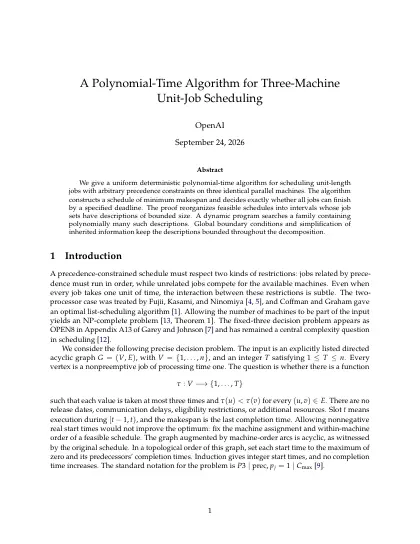
First page of A Polynomial-Time Algorithm for Three-Machine Unit-Job Scheduling

A Polynomial-Time Algorithm for Three-Machine Unit-Job Scheduling

OpenAI · September 24, 2026

We give a uniform deterministic polynomial-time algorithm for scheduling unit-length jobs with arbitrary precedence constraints on three identical parallel machines. The algorithm constructs a schedule of minimum makespan and decides exactly whether all jobs can finish by a specified deadline. The proof reorganizes feasible schedules into intervals whose job sets have descriptions of bounded size. A dynamic program searches a family containing polynomially many such descriptions. Global boundary conditions and simplification of inherited information keep the descriptions bounded throughout the decomposition.

Read PDF Download Source

Cite
@misc{OAI:A-polynomial-time-algorithm-for-three-machine-unit-job-scheduling-September-24-2026,
  author = {{OpenAI}},
  title = {{A Polynomial-Time Algorithm for Three-Machine Unit-Job Scheduling}},
  howpublished = {OpenAI Math Release preprint
                  \href{https://github.com/openai/math/blob/main/preprints/A-polynomial-time-algorithm-for-three-machine-unit-job-scheduling-September-24-2026/paper.pdf}{OAI:A-polynomial-time-algorithm-for-three-machine-unit-job-scheduling-September-24-2026}},
  year = {2026}
}

What was formalized in Lean

The following describes the scope of the Lean formalization related to the following accompanying paper(s):

Scope

The formalization gives a deterministic polynomial-time algorithm for scheduling nonempty collections of unit-length jobs with arbitrary acyclic precedence constraints on three identical parallel machines. It constructs a schedule of minimum makespan and decides exactly whether a valid specified deadline can be met. The algorithm is one fixed finite machine, and its running time is bounded by a polynomial in the binary input length.

Comparator links

ResultComparator statement
Optimal three-machine unit-job schedulingThreeMachine.lean

Scope note on GitHub →